November 18, 2014

Terrain Poetry Generator

Wow, I had created this blog post back in April, and for whatever reason, never published it. Anyway, here it is:

I've created a poetry generator to assist me with experiments in EMP-LIT. The resultant poems are a form of ASCII Terrain poem, in that the poems themselves resemble large (> 400 pages) world maps.

The generator was written in .python. I am still tweaking/updating, but you may have this version to play with: terrainpoetrygen.py

Further description from the code comments:

# ASCII Terrain Poetry Generator
# Sonny Rae Tempest
#
# 4/26/14
#
# Best viewed with monospaced fonts.
# Super-best viewed with monospaced typewriter fonts.
#
# This program will create a file named terrainpoem.txt in this directory.
# That file will be the poem.
#
# With default settings, will create a randomly generated poem > 400 pages
# at Courier New 12 pt font with ASCII characters chosen based upon their
# appearance related to terrain.
#
# Read from top to bottom, north to south, the poem which is generated
# will resemble a map of an enormous world, with changes in terrain determined
# randomly.
#
# There are near-infinite possibilities. You may need to run this program
# several times to experience all possible terrain.
#
# Be on the lookout for wildlife & small settlements.
#
# After all, this poem is their story.

Additionally, I'd published an iteration in book form on lulu, which I also forgot about. From the book description:
A Terrain Poem is a single iteration of my terrain poetry generator. I have included the python code for this generator in this book. This is an experiment in poetics and randomly-generated ASCII-style maps. The goal was to create a large-scale atlas from which a story would emerge. I chose this iteration because I really enjoyed the ending. srt #emp-lit
You may find it here: A Terrain Poem , or you may download a .pdf here: A Terrain Poem.pdf

Enjoy!
SRT

June 1, 2014

Authoring Generative Poetry via Game Worlds


** A Game about the Authorship of a Story about a Character in a Game. **

Goal: To explore methods of autoarchiving possible imaginative experiences of platformer-style video gameplay through the generation of textual narrative from within a game environment.

To keep this initial experiment manageable, a game world was created which exhibits a great degree of visual abstraction and traditional play mechanics. This way, the attention could be focused on text generation, and not gameworld aesthetics.

To build the game world in an expedient manner, I followed the tutorial available at http://www.programarcadegames.com/, which was simple enough to butcher once operational.

This work is partially inspired by the chapbook World 1-1 by Philip Miletic and Craig Dodman, in which both authors document actions within various playthroughs of the first level of the NES' Super Mario Bros. I feel that World 1-1 works superbly as an archive and as a written account of classic console gameplay, which this game strives to do.

Remainderly, inspiration comes from decades of wanting to develop a manner of logging actions, dialogue, &c. from old Sierra On-line PC games, so that I could read the story of my playthrough after completing the quest. Seems like a reasonable request.

------------------
Download (link at bottom of page), extract, and launch game.exe to start the game.

The game may be completed 3 different ways:
- Press 'q' to Quit.
- Fire all 6 bullets.
- Let 10-second timer expire.

The controls are as follows:
- 'a'     left
- 'd'     right
- 'w'     jump
- 'space' fire
- 'q'     quit

When the game environment opens, you have ten seconds to run around the house and fire your weapon. As you run around platform-style, each of your moves is logged and used to generate a short narrative about the game, the house, and the player (including an additional, unseen character). The more moves you make, the more passages will be generated in your logfile. When the game is over, a text file: gamelog.txt, is saved to the game's file location. Open this text file to read the generated work.


 ------------------

You may download game here: game.zip. Once downloaded, extract the .zip and run game.exe.

At this point, this game.exe has been tested only on Windows 8.1 64-bit. Please let me know if this works/works not in your Windows OS.

Enjoy!
SRT

February 14, 2014

Rogue: Menagerie

ROGUE: MENAGERIE is a conceptual text which aims to explore and experiment with translation, rhetoric, and archivism by a turn-by-turn documentation of play through an unsuccessful game of Rogue.

It available for download here: ROGUE: MENAGERIE

It is also available for purchase in print here: BOOK

Enjoy!

SRT

January 12, 2014

Ce n'est pas un virus.

Ce n'est pas un virus.

For Windows only.

Download at your own risk*.


Mwahahahahaha!

SRT

* It's perfectly safe. Use Task Manager to kill the task, or reboot. You'll be fine.

December 19, 2013

A Tabletop Dungeon Escape Game


Hello World.
 
I made a new game.
 
It's a tabletop dungeon escape game played atop QR code maps (all scan-able, yay!).
 
It is called Queen Regent's Dungeon Escape.
 
I made this for my kids for Christmas, but unfortunately didn't finish in time to receive a print of this, so I will need to print this on my printer for them.
 
But the book is now available here: Queen Regent's Dungeon Escape
 
I figured, since you can't get it by Christmas either, I will give you all a download of this book here: QRDE.pdf
 
You can print it from your printer.
 
This download will be available through December 25th, 2013.

Download and play with your kids!
 
Merry Christmas!
 
-SRT

November 5, 2013

345 - Fun w/ Numbers


I realized I hadn't updated this blog in a while (sorry, been busy with things I'm sure I'll update you about in the near future). So, I calculated you all a poem.

There are two ways to read 345: one way is to read it as a series of numbers, the other is to read it as a series of letters. 180-degrees, ya dig?

Here is the poem as a zip file of 13 images: 345_srt.zip

Um, Enjoy!

SRT

July 30, 2013

TERMINAL BOOT: An Experiment in EMP-LIT


TERMINAL BOOT is an experiment in translating methods and delivery of digital literature to a purely pen-&-ink medium. The load time of electronic work is here represented with printed words, producing a text which reflects not only the visual characteristics of a boot screen, but also the time taken to load a larger piece of software by an honest read-through.

Additionally, this book is an experiment in pacing, tension and resolution, through erratic progress indication.

The conclusion is intentionally open-ended, so that this book may serve as a thought-provoking standalone artifact, or as a prologue to any existing work of printed text.

It may be found here: TERMINAL BOOT

Enjoy!

-SRT

June 27, 2013

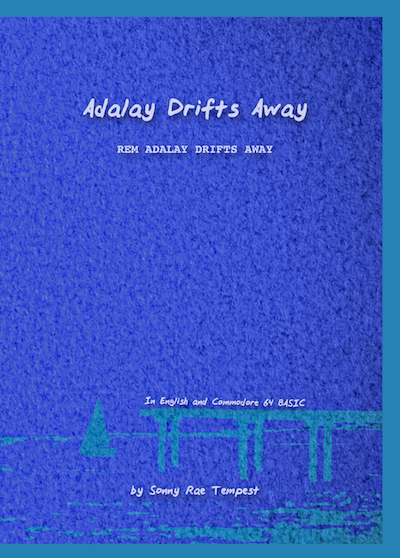
Adalay Drifts Away - Bilingual Children's Lit in English/BASIC

I'm not going to lie: I love the time of year for Cheerios books.

If you're not familiar, every year for a couple of months, Cheerios releases their Spoonfuls of Stories books, bilingual children's books (English and Spanish) that are included inside specially-marked boxes of Cheerios cereal. My kids love these books. I love these books. They are pocket sized, beautifully illustrated, and the along-side Spanish translation helps to reinforce the lessons which Dora the Explorer and her abrasive backpack have taught my 2-year-old about alternative languages (something this pocket of America so unfortunately lacks).

I've always wanted to write a Cheerios book. Now that I'm a grown up, I suppose I can.

But let's rewind to a time when I wasn't a grown up. I didn't have Cheerios books. The only marginally bilingual books that I owned looked like this:


This and many such books may still be found online at bombjack.org.

They were usually a series of short stories, or complete novellas, which, within the standard story prose, would contain snippets, or entire standalone sections, of code which could be entered into a BASIC interpreter. These pieces of code would enhance the story in one way or another, from displaying text on the screen to allowing entire games to be played to further the narrative. And while they didn't teach me Spanish, they taught me BASIC to at least a base level of competency.

Now I know there are many that will argue that BASIC is not a "language," and would not help to satisfy a language requirement toward degree completion, but honey nuts to that. By reading these books as a child, and inputting the printed code into the Commodore 64 BASIC interpreter, I was learning to communicate with a machine. There was no slang, no ambiguity, and my goodness, if I didn't get the syntax exactly right in every sentence which I "spoke," the machine would tell me, hand-slappedly, that I was doing it wrong (very much like my high school German teacher: "The Frau").

I've always wanted to write a BASIC-enhanced book. Now that I'm a grown up, I went ahead and did so. And to kill two birds &c., I've gone ahead and created a bilingual, Cheerios-style children's book, in English and Commodore 64 BASIC.

Adalay Drifts Away is a book that I wrote for my daughter to give her the same experience that I had growing up with a C64. Now that these machines are hard to come by, I've loaded an emulator on our home machine (Frodo for Mac OS). She's a little too young to input the code at this time, but with her daddy's assistance, she is able to experience a higher level of traditional storybook storytelling.

In a manner similar to that of Cheerios books, the English prose is set side-by-side with a BASIC translation of each scene. Rather than be a simple translation (like an English-Spanish one would be), the BASIC translation takes what is written in English and presents on-screen animation, audio, and other user-driven processes which directly reflect the words on the page.

I will admit, one of my favorite aspects of this is seeing the code written on the page. This, to me, proves the legitimacy of BASIC as a written language. If one is fluent enough, the need to input this into a machine goes away. The code becomes a set of signifiers which the brain can process and translate into mental images, audio, and other user-driven ideas, just as well as a machine can.

For a gift to my daughter, I've had this book printed, and if you are interested in receiving a hardcover copy, go here: Adalay Drifts Away. If you just want to check it out and get a better sense of what I'm talking about, I have made a lower-quality .pdf version which you may get here: Adalady .pdf.


Enjoy!

-SRT

May 18, 2013

Huckleberry Finnegans Wake

Next week I will be flying to Karlskrona, Sweden to perform Huckleberry Finnegans Wake along with fellow collaborators Talan Memmott, Eric Snodgrass, and Michael Maguire at The Mixing Realities Digital Performance Festival on May 24th. Here is a description of what we're doing:
Huckleberry Finnegans Wake  is a combinatoric performance work bringing together Mark Twain’s  Adventures of Huckleberry Finn and James Joyce’s Finnegans Wake.  With both texts based around river culture, folding one text into the other can form contextual imbrications and through this, combinatorial engines can be developed for the texts as well as implied visual and auditory material. Though both source texts are replete with exclusive language (regional dialects, neologisms, etc.) when brought together what emerges is a fantastical environment lacking specificity, but for the rivers (the Liffey and the Mississippi) that run through both. Imagine steamboats on River Liffey, the Pike County dialect being spoken in County Dublin, or Mutt and Huck on the banks of the Mississippi. The performance of Huckleberry Finnegans Wake utilizes a number of applications to generate a multi-modal interpretation of the combined text that includes visual material, audio, and live readings from various combinatorial engines.
 I'm pretty stoked, so if you're in the area, check it out!

- SRT

March 14, 2013

DRONE - A Pejorative Card Game

Portion of TARGET card

Drones bother me. Everything about unmanned aerial vehicles (UAVs), to me, screams: "I'm a pussy."

You can quote me on that.

I don't imagine I need to explain what they are, or what they're used for. But I will: They're machines used for killing people. They have no other purpose. They're used for killing people.

I've created game poems in the past, but when trying to address the drone issue, I could think of nothing "poetic" to communicate. Therefore, rather than create a poem about this particular subject, I've created more of a statement; to be more precise, I've created an expletive.

DRONE is a pejorative card game I designed based off a traditional deck of playing cards. The artwork was designed to signify anonymous targets, with piles of civilian deaths in iconic night-vision hues. The game play, the instructions, and the visual tone of DRONE is one which, however, was intended to be family friendly. Kids and adults of all ages can play this game without the gore and guilt of actual violence, which, quite frankly, reflects what I imagine is the viewpoint of the pilots themselves: totally removed from humanity, miles away, at a computer interface.

DRONE card
Number 7 card

You may download the instructions HERE as a .pdf, and play with a traditional deck of cards. Or you may navigate to HERE, where you may purchase the official deck (and make me a negligible amount of money).
Number 5 card
AGENCY card

I apologize if I've offended anyone. Drones bother me. But hey, the card game is fun! Again, this game truly is family friendly; it's satirical. Hopefully, if you're playing with your kids, they'll pick up on the wrongness of it all. Hopefully they'll get that feeling in their gut that they shouldn't be playing this game. And hopefully, so will you.

Thanks,

- SRT

March 8, 2013

Louisville Arcade Expo 2013


I regret that I hadn't brought this to your attention earlier (inexcusable, I know), but once again the Louisville Arcade Expo is bringing classic arcade games, pinball machines, and console games to the public this weekend. If you're in town, do not miss out on this event! I will once again be in attendance; this year I will be displaying Nothing is 0k, my generative poem for the Atari 2600.

For more information, please navigate to www.arcaderx.com. In addition to unlimited gameplay, there will be chiptune performances and game tournaments, as well as vendors selling classic games and game-related paraphernalia.

If you're in Louisville, this weekend, GO GO GO!!

-SRT

March 4, 2013

EMP-LIT: a New Course at UnderAcademy


Myself, along with Talan Memmott, Ray DeJesús, Sandy Florian, Linus Lancaster, Alan Sondheim, Erik H Rzepka, Rob Wittig, Claire Donato, Mark Marino, Jeff T. Johnson, Richard Smyth, and Maria Damon, will be teaching in the upcoming 4th Cycle at UnderAcademy College. Above is a flyer with a description for the class that I will be teaching, EMP-LIT, and is transcribed as follows:

Darkness. Sweet, silent darkness. The power’s out. Permanently. Piles of plastic. The network is down. The network is dark. Sweetly, silently dark.Where does electronic literature go when the power is out? Permanently? When the server no longer provides the PC? When the Personal Computer no longer provides the person?Into darkness. Into sweet, silent darkness.This class will explore and define methods of digital preservation beyond the place of power. Hypertextuality, generativity, multimedia interactivity: gone, replaced by piles of bargain-bin pop-sensational fiction, unless we work to analogize these methods to a platform with more longevity. In a first act of desperation, we will be transposing what we as electronic literates have discovered through digital composition back onto paper which, when all has become dark, sweetly and silently dark, can still be experienced by candlelight.
Admissions are open now. You may view other courses and enroll here now, free of charge.

A higher quality flyer may be found here.

Hope to see some of you there!

-SRT

January 27, 2013

Chargoggagoggmanchauggagoggchaubunagungamaugg


Lately I have been considering methods of preserving digital literature post-apocalypse. Not in a grim, Afternow kind of way (okay, maybe a little), but in a more realistically inevitable way. That is to say, at some point in the future of Earth, I imagine electrical power will be gone, and as such, so will the entire history of digital literature and all gained from its corpus.

To anticipate the permanent unreadability of e-lit (electronic literature), I have been toying with what I'll call EMP-lit (literature born after the great theoretical electromagnetic pulse that takes down our servers permanently). EMP-lit takes contemporary methods of digital storytelling such as hypertext, random text generation, audio and video presentation in conjunction with text, and translates them into a context that holds more longevity: that of tried-and-true ink on paper. One early example which I've completed is the poem Chargoggagoggmanchauggagoggchaubunagungamaugg.

For those who are not aware, Lake Chargoggagoggmanchauggagoggchaubunagungamaugg, also known as Lake Webster, is a lake in Massachusetts that was once a gathering place for the Nipmuc Indians. At 45 letters long, Chargoggagoggmanchauggagoggchaubunagungamaugg is one of the world's longest words. According to the Olde Webster website, the word is most accurately translated as: "Englishmen at Manchaug at the Fishing Place at the Boundary." Chargoggagoggmanchauggagoggchaubunagungamaugg is not only the title of this particular poem, but also serves as a constraint, in that the letters found in the title are the only letters used within the body of the poem, which I will now discuss in more detail.

This poem, which exists on paper and can be reproduced without the aid of a computer, uses concepts such as random map generation as well as visual animation. More precisely, there are 45 maps cards, each representing a portion of a fictitious river system, and each using one letter from the title to represent the area around the river, through which the reader is navigating. Using rules I created for Cimmerian Cell, the deck is shuffled and each card is picked from a deck and placed around each other as the boundaries of each card dictates. For example, if the first card drawn has three sides open, a card may be drawn and lain adjacent to the first card as long as that new card has an open side facing that of the original. For more detailed instructions for this, look HERE.

Sample Map card - 4 open sides

Sample Map card - 3 open sides

Sample Map card - 3 open sides


In addition to the map cards, there are 5 "occur" cards. When one of these cards is drawn, the reader sees a scene unfold from within his/her boat. These scenes are found in one of 7 flipbooks, each unmarked and shuffled like the map cards. When an "occur" card is drawn, the reader randomly takes one of the flipbooks and views the scene. Each scene is represented by text, which as mentioned above, is constrained by the letters found within the title. Be aware, however, that one of the flipbooks will bring death to the reader. This poem is meant to be experienced and re-experienced, and much like a video game, will produce different endings in each play.


Sample occur card

Sample Scene animation


If you die, the poem is over. If you can no longer place a new map card, the poem is over. If you play all of your map cards successfully, then the poem is considered read in its entirety, though because the reader has only experienced 5 of the 7 flipbooks, still has not seen the entire poem. So, experience it again.

All of the cards necessary for this poem can be found HERE. Rudimentary instructions for experience and construction can be found HERE. You may print and cut these cards out on regular paper, or print them on business card stock. More importantly, however, these cards may be reproduced by hand or by typewriter, and you have my absolute permission to use whatever reproduction methods as you see fit. The scenes for the flipbooks are all numbered, so that scene 1 will have its first animation cell labeled "1a" and the final cell labeled "1t." There are 20 cells in each flipbook. I used a stapler to bind the ones I produced; use a better method if you can.

Enjoy!
SRT

December 27, 2012

Gap - A Navigable Poem

Gap - A Navigable Poem - A Screenshot
Gap is a navigable poem that explores American masculinity.

What defines a "man" in America? Clothes? Job description? Dominance, through physical force or weaponry? Culturally acceptable addictions (eg. beer, coffee, gambling, porn)? From where are we choosing to learn about masculinity? From our parents? From our churches? From TV? Who gets to tell us what makes an acceptable/ideal man?

Gap explores these issues via navigable text. Within the poem, the reader controls a letter "A," a supposed Alpha male, a boat that can navigate the waters filling the gap between what is and what is not a man. This water gap through which the reader navigates is represented by an intentional text river, white space that is typically re-aligned in text to aid in readability, that runs between two mountains of words that comprise the poem. By sailing through this text river, the reader's "A" completes words and phrases as the poem is read from bottom to the top.

When discovering what defines manhood, not everything is clear. The world of the poem is dark, unknown, and the reader's torch illuminates a limited view of the entire text. In fact, the reader will never be able to discover every word written. No one male knows everything it takes to be a "Man."

As gender gaps slowly close in America, it is hard for a man to know his place concretely. While socially men may be (at least at some point) equal to women, naturally and biologically we are markedly different, and that's okay. Women amaze me at their ability to celebrate their womanhood.

Men scare me.

To read this poem:
- download the entire .zip file from here: Gap.zip
- Open the file Gap.exe.
- Control the "A" boat with the arrow keys (up, left, right; there is no going back).

At this point, this poem is only for Windows. It was written in .python and therefore I'll technically be able to create linux and (ugh) Mac versions; I just haven't yet.

Enjoy!

SRT

December 16, 2012

BUILD UP - A Playable Poem

BUILD UP is a playable poem about work, family, and the walls we build between them in just 8 hours per weekday.

BUILD UP is based on the classic game Breakout; or rather, it is an anti- version of the game, wherein you build up rather than break out, and is based on JavaScript by Nick Young (those web-nostalgic will love his link!).

Unfortunately, this poem only works in Chrome and Safari (looks smashing in Safari, actually). It will not work in Firefox or IE (sorry).

Click the alarm clock to begin, and use your mouse to play.

You may play it here: BUILD UP

Enjoy!

-SRT

December 10, 2012

And Sensibility Sense - A Novel of Cut-Up-Dialogue

And Sensibility Sense is a randomly generated novel based on Jane Austen's Sense and Sensibility.

Actually, it's pretty much the same novel, though each time the page is loaded, the dialogue within the novel is randomly selected from an array of all the dialogue in the original novel.

Let me give you an example:

From the original text of Sense and Sensibility (Chapter 9):
Sir John called on them as soon as the next interval of fair weather that morning allowed him to get out of doors; and Marianne's accident being related to him, he was eagerly asked whether he knew any gentleman of the name of Willoughby at Allenham. 
"Willoughby!" cried Sir John; "what, is HE in the country? That is good news however; I will ride over tomorrow, and ask him to dinner on Thursday."
"You know him then," said Mrs. Dashwood.
"Know him! to be sure I do. Why, he is down here every year."
"And what sort of a young man is he?"
"As good a kind of fellow as ever lived, I assure you. A very decent shot, and there is not a bolder rider in England."

Now here is the same excerpt from one run of And Sensibility Sense (Chapter 9):

Sir John called on them as soon as the next interval of fair weather that morning allowed him to get out of doors; and Marianne's accident being related to him, he was eagerly asked whether he knew any gentleman of the name of Willoughby at Allenham.
‘I sent you up the young man. Did not I do right?‚-And I suppose you had no great difficulty‚-You did not find him very unwilling to accept your proposal?’ cried Sir John; ‘I think, Edward,’
‘Colonel Brandon!’ said Mrs. Dashwood.
‘A very simple one‚-to be of use to Mr. Ferrars.’
‘you know that all this is an invention of your own, and that there is no such person in existence.’
‘I could meet him no other way. Eliza had confessed to me, though most reluctantly, the name of her lover; and when he returned to town, which was within a fortnight after myself, we met by appointment, he to defend, I to punish his conduct. We returned unwounded, and the meeting, therefore, never got abroad.’
An exploration of unintentional narrative, each reading will be quite unique, as the rearrangement possibilities are, while not endless, certainly more than I'm willing to calculate.

As Burroughs would have recommended the scissors, I recommend the javascript. Steal this work, and create your own.

Once again, here is the link: thefwordsrt.appspot.com/andsensibilitysense.html

Enjoy!
-SRT

November 29, 2012

Conway's Game of Good and Evil

Conway's Game of Good and Evil

Taking John Conway's Game of Life and infusing the words "GOOD" and "EVIL" within the void, a page (world) of ever-evolving text appears.

If you're unfamiliar with cellular automata or Conway's Game of Life, it essentially places a certain set of rules on displayed objects that determine whether or not they'll live or die in the next "step" of the program depending on how many "neighbors" each object has.

The Game of Life program has me hypnotized and amazed every time I open it. It's available for a variety of platforms and languages, but if you haven't seen it before, check out this page: Emergent Universe - Game of Life.

Textual Automata
I've altered the code found here to grab letters from an array, in this case the letters from GOOD and EVIL, and display those letters instead of simple pixels. What results is a fascinating, living, breathing, dying, evolving text that explores many ideas inherent in life.

As the text evolves, you get typical Game of Life patterns (blinkers, boats, gliders, spaceships, &c). In addition, you get a story that begins with a VOID, and fills this VOID with GOD, LOVE, and even EVE. Allow the story to self-evolve, and you may come across the VILE, the DEVIL, maybe an IDOL or two.


Moving beyond a story of creation, the text becomes populated with DOVEs, DOGs, even an occassional EEL. As the story progresses further, these concepts may be replaced by an attraction to GOLD or OIL.

These words LIVE, EVOLVE, and DIE like any other life as we know it. By adding equal parts GOOD and EVIL to the system, I find it fascinating to see the products of the blend of the two.

Stable Configuration

This program is available for Windows and can be downloaded here: Game_of_Good_and_Evil.exe

If you'd like to build the program yourself, the C++ code is here: Game_of_Good_and_Evil.rtf
Run the program and watch it evolve into a stable pattern. Run it again, and the void will be filled with a different pattern (they're created at random). Run it to read it or run it to stare. If nothing else, run it to create worlds.

-SRT

November 11, 2012

UNWELCOME - a Screenshot Poem

Original Screenshot - Metroid, NES

Experimenting with sprite poems, I decided to see what an entire screenshot would look like. For this piece, I chose a screenshot from the initial scene of Metroid for the NES.

Replacing each pixel in the screenshot with a color-corresponding letter infuses the word "unwelcome" throughout the scene where Samus first arrives in the game-world.

Unwelcome is the hostile world to her. Unwelcome is she to a world into which she was not invited. Unwelcome is she in a 1986 8-bit sci-fi video game where she hides her identity until after the game is over, so not to offend or excite the target market.

The resultant poem seems less like ASCII art and more like a cross stitch pattern. Each pixel is carefully mapped and its color referenced as one letter in the word "unwelcome."

This project was done entirely in a text editor, with a monospaced Courier to maintain an even character width. As such, it is copy-able and paste-able into any other text editor. It is not an image. It is a string of letters, one pervasive word.

Here is the poem as plain text: UNWELCOME_bw.pdf

Here is the poem in color: UNWELCOME_color.pdf

(Downloading and opening looks much better than previewing on Google docs.)

Zoom in. Zoom out. Forests and trees and such.

SRT

October 2, 2012

A Picture Worth 11,739 Words

A picture worth 11,739 words


This afternoon, I was playing around with some images, glitching them up through a hex editor, because sometimes that's what I do during my downtime at work. Those who recognize the screenshot as Spiceworks will probably guess what I should have been doing while I was creating this image. While modifying the code, I began drifting into thought. I began wondering what, deep into this image's code within which I was working, was this image trying to say, beyond that of the product of a typical image viewer?

So I removed myself from the hex editor, and tried a text editor. Well, we all know that the text editor will display a bunch of gibberish, since looking at the code of such a file is not really the text editor's job. Okay, I understand that.

So here's what I did next:

1) Changed the character encoding of what the text editor (in this case: Word) presented into Chinese.
2) Copied the Chinese characters into Google translator, and translated into English.
3) Copied the now-English text back into the text editor.
4) Ran a spell check, making every suggested change along the way.

The result is here in .pdf format: CAPTURE.PDF

What began as gibberish is now 11,739 words, most of which are readable to some degree. Here are a few of my favorite quotes from this text:

"and obesity have been implicated with premature failure of the implant by loosening, fracture"
"throwing the world the sobbing tender"
"Beam roars me? Radiance of fire, the petal"
"Song s? Naked? The Run violence?"
"the defecate + ingot official pay the Hour Ling F * N, few paid"
"Complain? 0 species of bamboo"
"executive irresolute Shang trafficking curse? earn?"

are among many others.

Try this on your own, with a variety of images. Look for stories unfolding within.

Find out exactly, and in how many words, the worth of your picture.

-SRT

September 17, 2012

Famicommunist Poetics

Famicommunist Poetics flyer

This fall, I will be teaching a class at UnderAcademy College entitled Famicommunist Poetics. The course description is as follows:

"This class will explore Famicommunist aesthetics and constraints from within a post-Fujian framework. We will experience existing work that has ranged from the textual, to the visual, to the procedural, through many points in between. In addition, we will produce an extensive portfolio based on our non-digital experimentation with ASCII, sprites, volition, easter eggs, cheat codes & passwords, as poetic forms and constraints, in addition to others that will be created within the class."
In a nutshell, in this class we will be composing concrete poetry based on the visual aesthetics and input methods of classic video games. By classic, I am referring to games released during what I call the Fujian era, i.e. the years during which the Atari VCS was produced (1977-1992). This will by no means limit us to games released on the Atari console, but rather the games and consoles that were released during this time period, including, but not limited to, the Nintendo Entertainment System, Sega Master System, various handhelds, arcade cabinets, &c &c &c.

Anyone is welcome to register for the class through the UnderAcademy website. If you are unfamiliar with UnderAcademy, I highly recommend checking out their website for further info. Registration will be closed once the class hits 15 students, so don't wait!

In addition to Famicommunist Poetics, I will also be co-teaching a class with every other UnderAcademy digressor entitled Too Many Cooks. You may find more info on this class, and others, here: UnderAcademy Courses

While I'm discussing UnderAcademy, I also want to note a couple things that have developed there since my last blog post:

During the summer, Associate Professor of writing at University of Southern California Mark Marino led a special, steamy seminar entitled Grammar Porn, and has posted highlights of student work in Bunk Magazine, which can be found here: Bunk Magazine

Quite recently, The Chronicle of Higher Education posted an article on their Wired Campus blog regarding UnderAcademy, which you can read here: The Chronicle

If you have any questions about UnderAcademy or these classes, feel free to contact me. Hope to see some of you on the roster!

-SRT